By Matthew Venne
Chief Technology Officer, stackArmor
Every week across the cloud industry, the same ritual repeats: a vulnerability scanner flags a CVSS 9.8 “Critical” CVE in an open-source utility, an automated alert fires, an SLA countdown starts, and an engineering team drops everything to push an emergency patch.
Nobody asks what the affected asset actually does. Nobody asks what data it can touch. Nobody asks if it has an ingress route from the internet, or if it runs for twelve minutes at midnight in an isolated VPC before self-terminating. The compliance checkbox says Critical, so the patch goes out.
Two hours later, that rushed deployment introduces a subtle race condition in the database connection pool, taking down the entire service for three hours.
In the name of "security," the team just created the exact catastrophic loss of availability they were supposedly trying to prevent.
This illustrates a persistent challenge in modern vulnerability management: distinguishing vulnerability hygiene from risk management.
Viewing FedRAMP’s Vulnerability Detection and Response (VDR) and Vulnerability Evaluation and Reporting (VER) mandates primarily as a faster process for patching scanner findings overlooks their broader value. VDR is not simply about eliminating every vulnerability from every container. It is about quantifying and managing risk.
1. Risk Has a Formula: Threat Models and the CIA Triad
In information security, risk is not the mere existence of a bug.
Risk is the quantified potential for loss or damage when an adverse event impacts any combination of the Confidentiality, Integrity, or Availability (CIA) of a system. It is a function of three interconnected variables:
To evaluate risk, you must start with a realistic threat model. And when you look honestly at real-world operational telemetry across enterprise SaaS and Cloud Service Providers (CSPs), you run headfirst into an operational reality:
A significant amount of severe outages, data corruptions, and system disruptions are not caused by nation-state zero-day exploits. They are caused by misconfigurations, failed migrations, human error, and botched, rushed software deployments.
Anyone who has worked with me has probably heard me say: "You're not a senior engineer until you've taken down prod at least twice." That isn't an excuse for sloppy engineering—it's the reason we have Change Management, peer code reviews, canary deployments, and architecture boards in the first place: to mitigate the very real risk of operational self-harm.
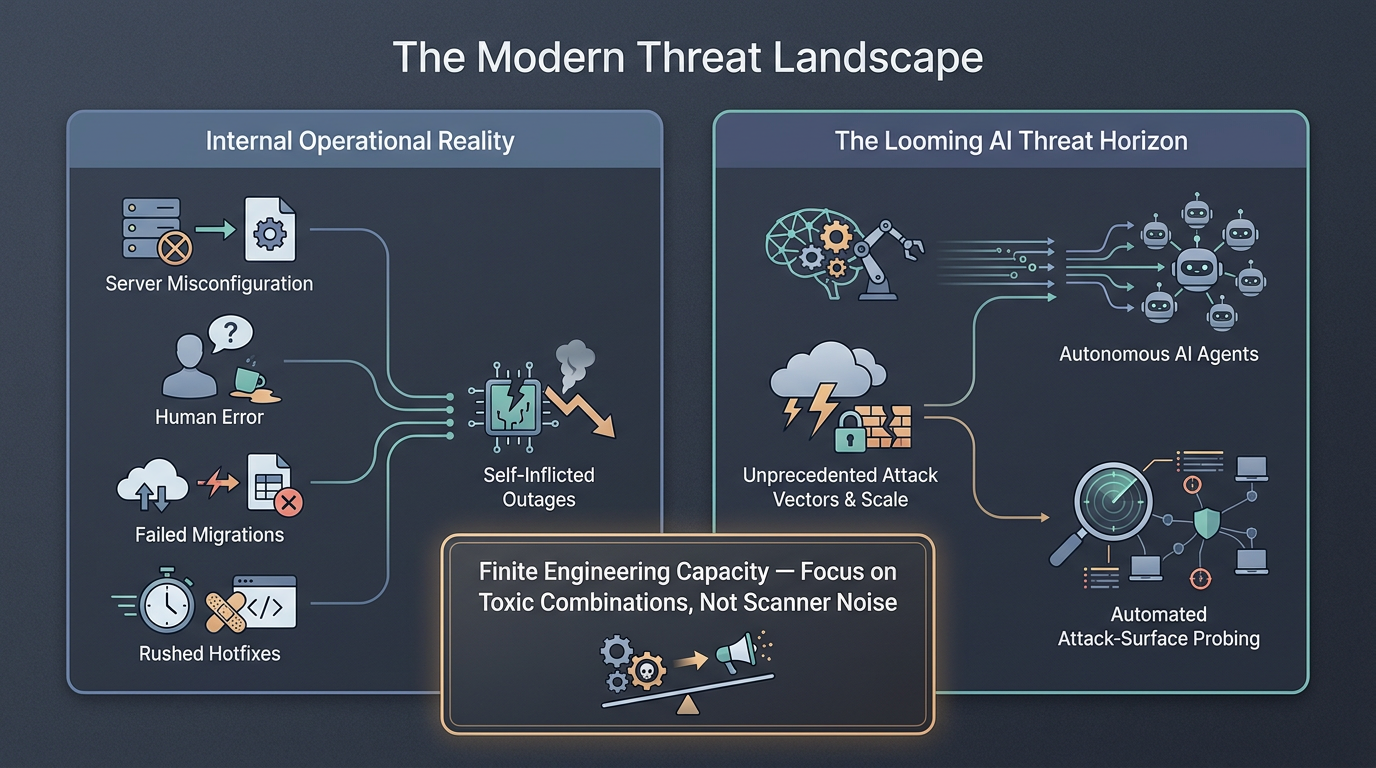
At the same time, the advent of AI in cybersecurity cannot be trivialized. We are already starting to see near-daily occurrences of nation-state backed, autonomous AI hacking systems scanning, probing, and weaponizing attack paths at machine speed.
This is precisely why risk-based remediation prioritization is critical.
Engineering capacity is finite. Organizations have limited developer hours, maintenance windows, and operational bandwidth. An emergency remediation cycle should therefore be reserved for findings that meet meaningful risk criteria:
- A high-impact vulnerability (capable of catastrophic technical damage),
- On a high-value asset (holding crown-jewel federal data or core control-plane functions),
- That is likely exploitable (known active exploitation or high EPSS probability), and
- Internet reachable (exposed to unauthenticated external payloads).
In the terminology popularized by Wiz, that alignment represents a true "Toxic Combination."
If a finding does not represent a toxic combination, initiating an emergency remediation cycle may divert engineering capacity from more consequential threats while introducing unnecessary operational risk.
2. The Asset Security Impact Profile: Why the Box Matters More Than the Bug
In our white paper, A Deterministic, CVSS-Environmental Method for FedRAMP VDR/VER Prioritization, we highlight that CVSS Base Scores measure vulnerability severity in a vacuum on a hypothetical server.
FedRAMP’s Potential Agency Impact (PAIN, levels N1–N5) asks a fundamentally different question: "What is the actual potential impact to the federal agency if this specific asset is compromised?"
To answer that, every asset in your architecture must have an Asset Security Impact Profile—an uncapped vector representing its independent Confidentiality, Integrity, and Availability Requirements (CR / IR / AR). When you evaluate vulnerabilities through this architectural lens, context completely changes the priority.
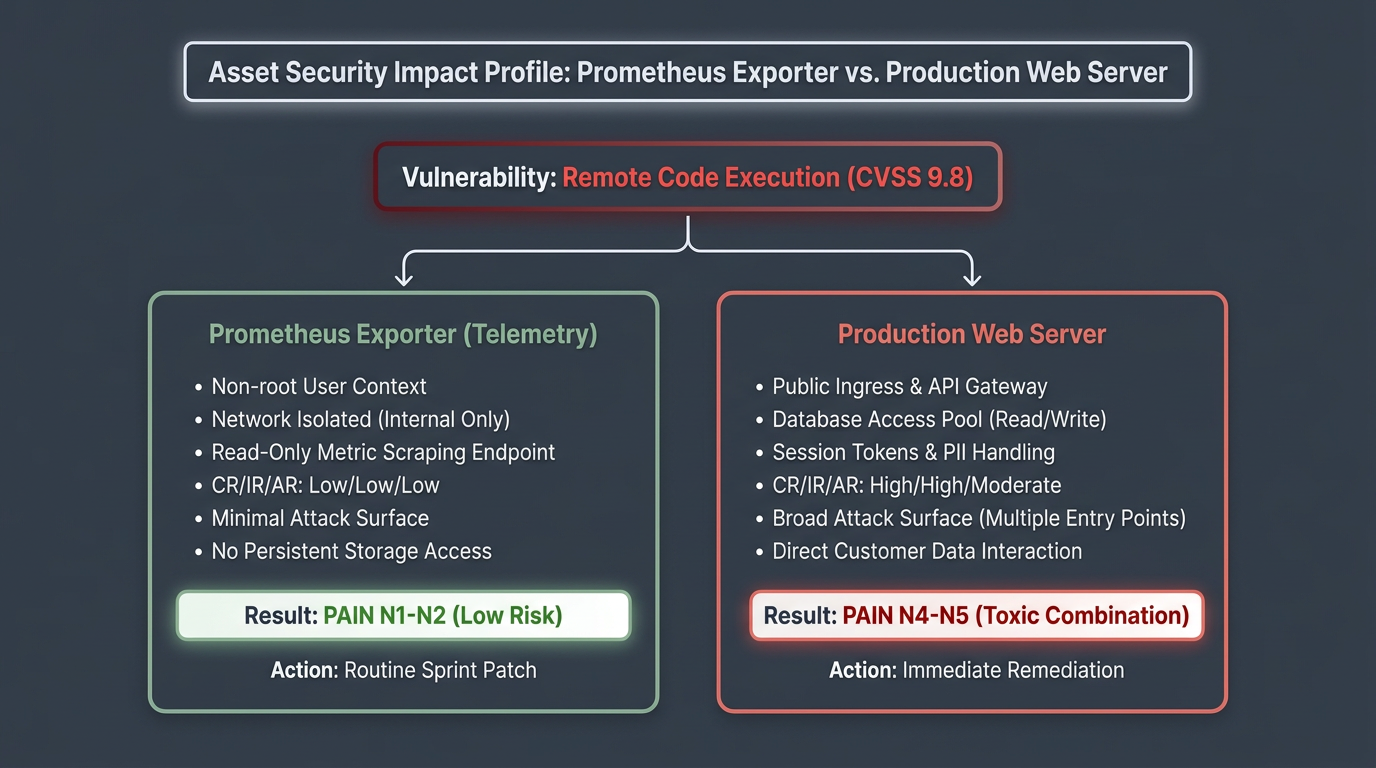
Let’s look at two concrete examples:
Example A: Prometheus Exporter vs. Production Web Server with DB Access
Imagine a high-severity Remote Code Execution (RCE) vulnerability in a logging or parsing dependency present across your entire container fleet.
- Asset 1: A Prometheus Metrics Exporter (
node_exporter)- Architectural Role: Scrapes CPU, memory, and network telemetry on an internal node and serves it to a local monitoring scraper.
- Privilege & Data Boundary: Runs as an unprivileged, non-root service without elevated host capabilities, without host-filesystem mounts, and without privileged access to the monitored resource or application memory.
- Asset Impact Profile: CR: Low / IR: Low / AR: Low.
- The Threat Scenario: If an attacker somehow exploits this exporter, what is the damage? Because it holds no credentials and cannot manipulate the underlying host or database, Confidentiality loss is minimal (they see aggregate metric time-series, not tenant records). Integrity loss is low (skewed metric graphs). Availability loss is minor (a temporary blind spot in monitoring, while the core customer application remains fully operational).
- Asset 2: A Customer-Facing Web Application Server
- Architectural Role: Terminates customer TLS, handles authentication, and maintains an active connection pool with read/write credentials to the primary transactional database.
- Asset Impact Profile: CR: High / IR: High / AR: Moderate.
- The Threat Scenario: An exploit here gives the attacker direct memory access to session keys, customer PII, and an active SQL channel into the database containing federal records. Confidentiality and Integrity damage is severe or catastrophic.
Under a raw vulnerability model, both get stamped "Critical" and assigned an identical 7-day or 14-day remediation clock. Under a risk model, the web server represents a Toxic Combination and an urgent N4/N5 priority, while the unprivileged Prometheus exporter is an N1/N2 finding that can be safely folded into standard sprint maintenance.
Example B: Ephemeral Batch Job vs. Persistent Mission-Critical Workload
- The Ephemeral Batch Worker: A containerized reporting task spins up once a day at 02:00 AM in a private subnet with no public IP, pulls raw data, transforms it, writes a report to an object bucket, and terminates after 12 minutes. It has no inbound listening network ports and its credentials expire upon task completion. While any CVE in this container should be tracked and remediated via routine base-image rebuilding, its exposure window and exploitability profile are negligible.
- The Persistent Backbone Workload: An always-on message broker (e.g., Kafka or RabbitMQ cluster) running 24/7/365, orchestrating state transitions across all microservices. A vulnerability here sits continuously exposed to internal network traffic, holds persistent connections, and represents a single point of failure for system-wide Availability.
Prioritizing the ephemeral worker at the same urgency level as the persistent broker is not security rigor—it is an operational misallocation of engineering resources.
3. The Multi-Agency Multiplier: Why Blast Radius Scales with Tenancy
Risk is fundamentally about potential loss. If a security event compromises a system, the severity of the damage depends heavily on who is affected.
Compromising an asset that processes data for five different federal agencies inherently causes vastly more damage to national security, federal operations, and public trust than compromising an asset dedicated to a single agency program.
Under the FedRAMP VDR/VER framework and our upstream derivation paper, Before the PAIN Equation: Deriving Security-Requirements Ceilings from Intended Federal Information Types, multi-agency scope acts as a critical envelope multiplier.
When multiple agencies share an asset, the effective Security Requirements ceiling (Ex) for each dimension (o ∈ {C, I, A}) is calculated as the maximum over all definite affected agencies (Ax):
If Agency A requires Confidentiality: Moderate and Agency B requires Confidentiality: High, any shared component that can affect both agencies inherits the High ceiling.
What the Industry and CSP-AB Are Seeing
FedRAMP unfortunately—or perhaps fortunately, depending on how much architectural flexibility you want—gives CSPs some leeway on how they define and calculate their internal PAIN classifier.
However, from our ongoing conversations with engineering leaders across the industry and members of the Cloud Service Provider Advisory Board (CSP-AB), many forward-thinking CSPs are converging on a very similar required-inputs philosophy to stackArmor’s, even if their specific scoring arithmetic or weighting curves vary slightly.
Providers adopting structured, risk-grounded models are increasingly recognizing that multi-agency scope must be reflected in PAIN evaluations. A shared multi-tenant control plane presents a different potential impact than a single-tenant silo, and the risk model should account for that distinction.
4. Multi-Tenancy Architecture: The Engine Behind Multi-Agency Risk
Whether an asset is "multi-agency" is not an arbitrary tag. It is a direct function of the CSP's multi-tenancy architecture and active customer base.
First, ask the foundational business question: Does the CSP actively have multiple federal agency customers in this authorization boundary? If a CSP has only one federal tenant today, all workloads are single-agency in reality, regardless of whether the software is theoretically capable of multi-tenancy.
Second, examine how the CSP actually implements tenancy in its infrastructure:
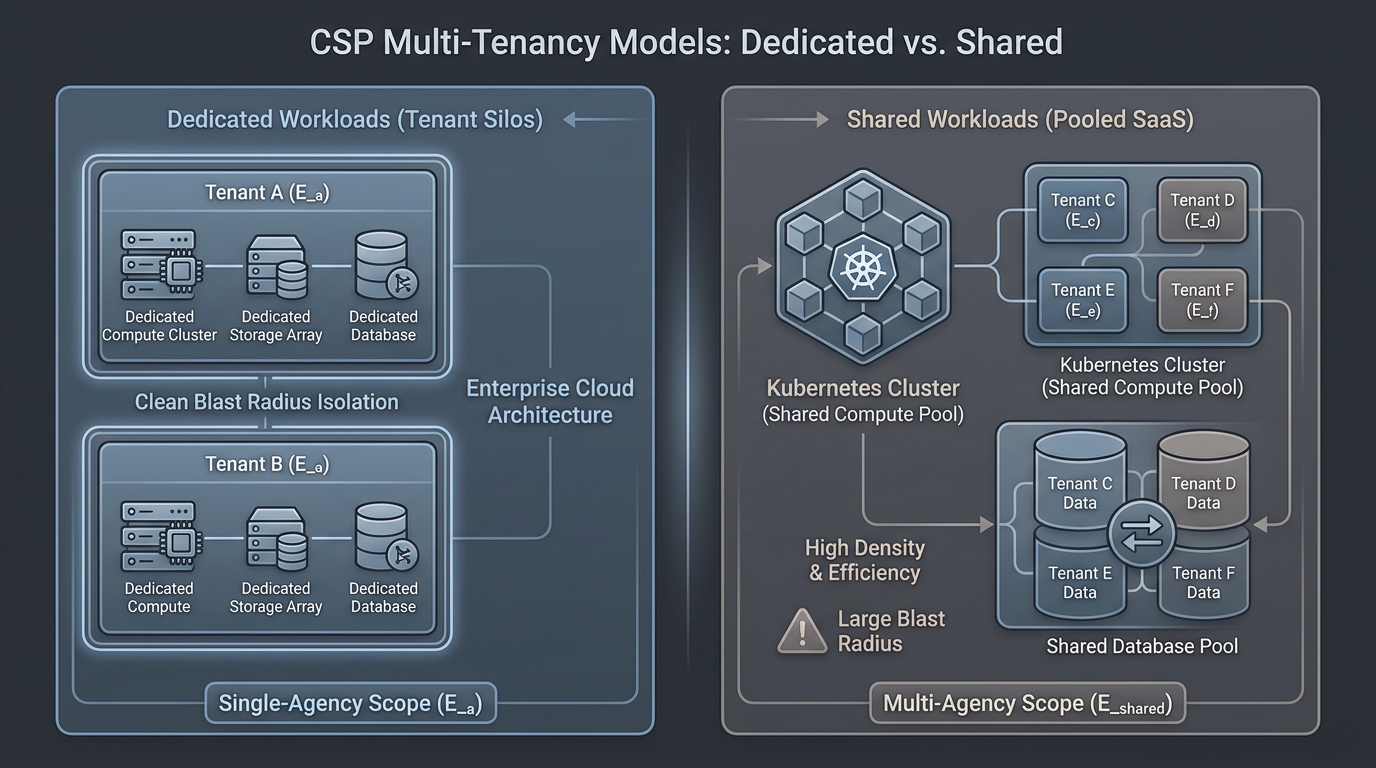
1. Dedicated Workloads (Tenant Silos)
In a dedicated model, each agency tenant is provisioned its own isolated infrastructure stack (dedicated VPCs, separate Kubernetes namespaces/clusters, and distinct database instances).
- Advantages: Hard isolation boundaries. A breach or performance degradation in Tenant A's container cannot spill over to Tenant B. Remediation triage on Tenant A’s dedicated worker evaluates only Tenant A’s FIPS 199 ceiling.
- Disadvantages: Significant infrastructure cost overhead, resource underutilization, and operational complexity in managing dozens of disparate environments.
2. Shared Workloads (Multi-Tenant Fleet)
In a shared SaaS model, multiple agency tenants share the same compute pools, microservices, and multi-tenant databases, isolated only by software-level constructs (tenant IDs, RBAC policies, and application logic).
- Advantages: High resource density, cost efficiency, centralized scaling, and a single CI/CD pipeline to patch.
- Disadvantages: High-consequence blast radius. A memory corruption or privilege escalation vulnerability on a shared application pod instantly puts every agency customer at risk.
5. The Real-World Reality: The Hybrid Architecture
In reality, many enterprise CSPs are not purely 100% dedicated or 100% shared. Production architectures frequently adopt a hybrid mix.
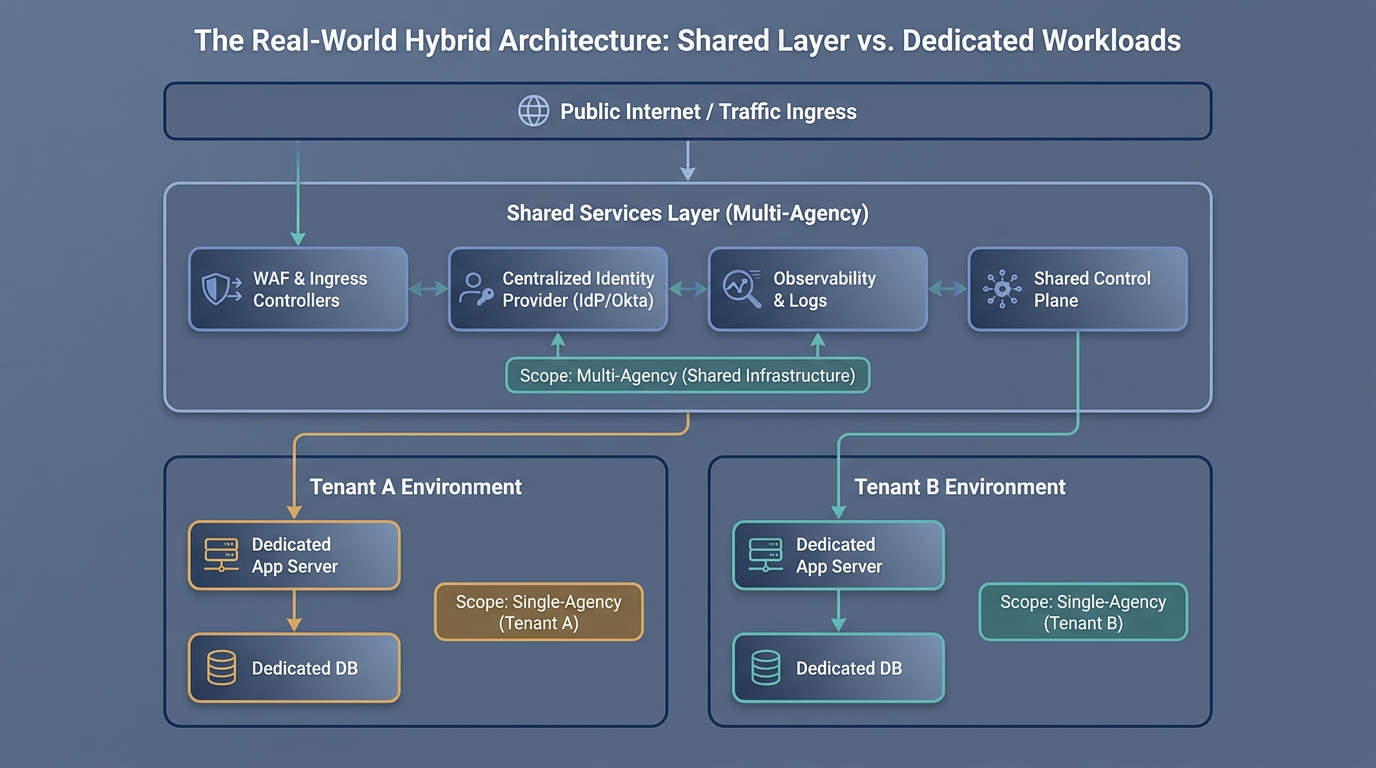
A well-architected CSP typically splits its environment into two distinct tiers:
A. Shared Services Components → Treated as Multi-Agency
Components that route, authenticate, orchestrate, or monitor traffic across all tenants:
- Public Load Balancers, API Gateways, and Ingress Controllers
- Centralized Identity & Access Management (IdP, OAuth/OIDC brokers)
- Observability, SIEM log collectors, and audit backbones
- Deployment pipelines and control-plane orchestration nodes
Risk Treatment: If the CSP serves multiple federal agencies, these shared components must be evaluated against the combined Multi-Agency Security Requirements Ceiling. A vulnerability here represents a systemic risk to all tenants. Triage must reflect the heightened blast radius.
B. Tenant-Dedicated Services → Treated as Single-Agency
Components provisioned exclusively for a specific tenant within the same authorization boundary:
- Dedicated application worker pools
- Per-tenant database instances or partitioned storage volumes
- Agency-specific integration connectors
Risk Treatment: These components should be evaluated strictly as Single-Agency. If Tenant A is processing Moderate-impact data, a vulnerability in Tenant A's dedicated worker is scored against Tenant A’s ceiling—it is not artificially inflated to High just because Tenant B uses a different part of the platform for High-impact data.
This hybrid approach allows CSPs to maintain architectural efficiency without inflating remediation overhead or obscuring true systemic risks.
6. The Operational Consequences of Mis-Quantifying PAIN
For security and compliance teams operating within FedRAMP CSPs, there is often a powerful temptation to play it "defensively safe." When faced with ambiguous scanner output, some teams reflexively classify findings at the highest possible tier to avoid second-guessing by auditors.
However, this approach can work against what PAIN quantification is intended to accomplish.
Under FedRAMP VDR and VER requirements, PAIN ratings are not passive spreadsheet entries. They carry binding operational consequences. Specifically, high-consequence findings trigger mandatory out-of-band incident notifications and security escalation reports to federal agency customers for N4 and N5 vulnerabilities, with mandatory escalation windows tied to Likely Exploitable (LEV) and Internet-Reachable (IRV) conditions across Certification Classes.
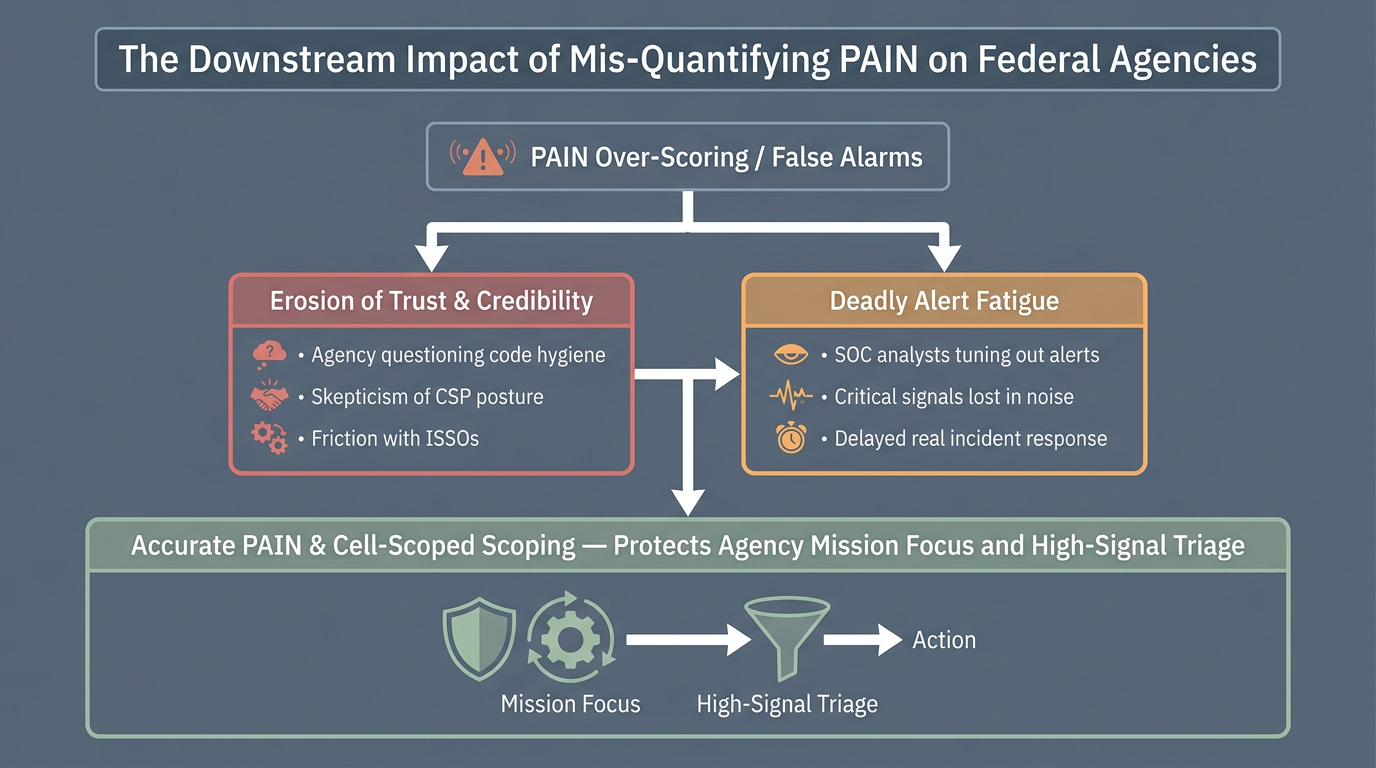
When a CSP fails to rigorously quantify PAIN and instead inflates scores out of compliance anxiety, the downstream effects on federal customers are severe:
- They destroy customer confidence in the platform's core security. When an agency ISSO is inundated with near-daily "High/Critical Incident Notifications" for vulnerabilities on internal, isolated components, their takeaway isn't "This CSP is so vigilant." Their takeaway is: "Why is this platform constantly on fire, and why is their engineering hygiene so undisciplined?"
- They induce fatal alert fatigue across federal operations. Every engineer on the planet understands alert fatigue. When agency Authorizing Officials (AOs), ISSOs, and SOC teams are continuously spammed with emergency notifications for non-debilitating findings, they inevitably begin to tune them out. When a genuine crisis occurs, it drowns in the noise.
Understanding the Difference: Accurate PAIN Quantification in Practice
To see why mathematical rigor in PAIN classification matters to both CSPs and agencies, consider three real-world operational scenarios:
Scenario 1: The Mis-Quantified Internal Utility
- The Finding: An unauthenticated Denial-of-Service flaw in an internal log aggregator.
- The Inflation Mistake: The CSP sees "CVSS 8.5 High" and defaults to an N4 / High Impact rating, triggering mandatory agency incident alerts.
- Accurate PAIN Quantification: The asset is an internal collector (Rlog = L/L/L). The technical consequence is strictly Narrow. Under proper CVSS-Environmental derivation, it scores as N1 or N2. It is safely queued for the next maintenance release without generating false panic.
Scenario 2: The Multi-Agency Crown Jewel (A Genuine Emergency)
- The Finding: An unauthenticated authentication bypass or remote code execution in the shared Identity Provider (IdP) or API Gateway.
- Accurate PAIN Quantification: The asset holds credentials for all tenant agencies (RIdP = H/H/H, Multi-Agency scope). The consequence is unmistakably Debilitating. It correctly and deterministically calculates as N5. The emergency incident notification to all customer agencies is completely warranted, expected, and treated with absolute urgency.
Scenario 3: The Single-Tenant Data Leak (and the Importance of Cell-Based Scoping)
- The Finding: An information-disclosure flaw on a tenant-dedicated data processing worker provisioned solely for Agency A.
- The Inflation Mistake: The CSP treats the entire multi-tenant system as a single undifferentiated blob, marking the finding "Multi-Agency High" and blindly notifying Agencies A, B, and C.
- Accurate PAIN Quantification: The asset is dedicated (Ax = {Agency A}). The scope is evaluated strictly against Agency A's ceiling. Agencies B and C are not needlessly alarmed, and Agency A receives an accurate, properly scoped report.
- The Industry Benchmark: We should give credit where it's due: Okta does this exceptionally well with their cell-based SaaS architecture. Okta sends automated notifications of detected potential security incidents, but strictly scopes them to individual Cells. If an agency customer is running in Cell A, why on earth should they be panicked with an incident alert for an event confined entirely to Cell B? Proper architectural scoping keeps incident notification truthful, accurate, and actionable.
Agency customers deserve to have their focus protected. They have critical public missions to execute, and their security personnel should only be pulled into an emergency posture when a vulnerability’s discovery genuinely threatens to debilitate their operations.
7. The Honest Objection: What Stops a CSP From Scoring Everything Down?
If your reaction to all of this is, "Isn’t this just a very sophisticated argument for patching less?" — it seems like a fair question.
It is a reasonable concern, but CSPs already had a mechanism for documenting these decisions through the Deviation Request (DR) process.
Under the legacy FedRAMP model, whenever a CSP couldn’t meet an SLA or determined a scanner finding wasn't a real-world threat, they filed a Deviation Request. It was a bespoke, cumbersome prose essay arguing why the vulnerability wasn't as bad as the scanner claimed.
The old process was broken in three critical ways:
- It was un-auditable: An agency ISSO had no independent tooling or telemetry to verify whether the CSP's written narrative was accurate.
- It wasn't standards-based: Every ticket was a subjective, bespoke argument written by different engineers in different formats.
- It collapsed under volume: When hundreds of DRs landed on an agency's desk, Authorizing Officials (AOs) had two bad choices: halt operations, or blindly rubber-stamp paperwork to survive the queue.
CSP-asserted risk re-scoring was already the reality. What VDR actually did was move the Deviation Request to the very beginning of the lifecycle.
From Individual Justifications to Method-Level Auditability
Instead of forcing AOs to review hundreds of ad-hoc justifications after the fact, VDR demands a standards-based, traceable methodology up front:
- The Logic is Locked Before the Scan: The derivation method (anchored in CVSS Environmental metrics, NIST SP 800-60 impact baselines, and architectural reachability) is published in the SSP and codified in telemetry.
- Every Score Movement is Legible: If an N5 is dispositioned to an N3, the record explicitly captures why—naming the exact architectural variable or compensating control that reduced the risk.
- Auditability Scales: No AO can audit 500 subjective prose tickets. But any AO can audit one transparent derivation formula and spot-check 10 or 20 findings against the math.
When a CSP scores a finding down on the strength of a compensating control (like continuous transaction-log PITR with a 5-minute RPO or default-deny network boundaries), they have just made that specific control directly auditable.
Built for Transparency: Flexible by Design, Defensible by Default
This is precisely why stackArmor’s PAIN methodology was engineered to be open, transparent, and flexible.
We explicitly define the exact architectural conditions and threat criteria that elevate a vulnerability to debilitating (N5) versus disruptive (N3/N4) or routine (N1/N2). While we feel strongly that our default position is 100% technically justifiable and represents the most effective risk-balanced posture for federal workloads, we acknowledge that risk tolerance is never one-size-fits-all.
Crucially, this framework is designed to enable a constructive risk conversation between the CSP and the Authorizing Official. If an agency has specific mission sensitivities, unique data handling constraints, or differing risk appetites, the model isn't a rigid black box. It provides a structured, shared language where the CSP and AO can collaboratively calibrate impact baselines, reachability assumptions, or asset criticality.
Because the entire derivation is open and deterministic, any agreed-upon adjustment recalculates cleanly across the fleet—turning what used to be endless bureaucratic friction into an auditable, collaborative risk decision.
The AO still holds the pen, but VDR enables that oversight to be supported by transparent calculations, verifiable telemetry, and traceable evidence rather than narrative justification alone.
We don't ask agencies to blindly trust CSPs to score their own risk. We require CSPs to show their work from day one.
8. The Takeaway: Stop Counting CVEs, Start Modeling Risk
When vulnerability management degenerates into a blind rush to clear scanner queues, security teams lose sight of what they are protecting.
| The "Security Hygiene" Treadmill | The "Risk-Driven VDR" Model |
|---|---|
| Focuses on raw CVSS Base Scores in isolation | Evaluates Potential Agency Impact (PAIN) in context |
| Scrambles on every CVE regardless of asset role | Prioritizes true "Toxic Combinations" (Impact + Asset + Threat + Reachability) |
| Treats all servers running the same OS as identical | Differentiates by Asset Security Impact Profile (CR / IR / AR) |
| Ignores workload lifecycle and network reachability | Separates ephemeral internal jobs from persistent public ingress |
| Treats multi-tenancy as a binary checkbox | Maps blast radius directly to CSP Multi-Tenancy Architecture |
| Inflates PAIN out of compliance fear, driving alert fatigue | Quantifies PAIN accurately, preserving agency focus for true emergencies |
| Causes deployment churn and self-inflicted outages | Balances patching urgency with operational stability |
FedRAMP’s VDR/VER framework gives the cloud community the exact tools needed to escape the scanner trap. By anchoring vulnerability triage in threat modeling, asset-level consequence, intended information types, and tenancy-aware blast radiuses, providers can defend their systems against malicious adversaries, operational self-harm, and administrative exhaustion.
VDR isn't about proving you can patch 500 low-risk packages in 7 days.
It’s about making sure that when an issue genuinely threatens agency data or system availability, you know exactly where it is, what it touches, and why it matters.
Further Reading & Technical References
- A Deterministic, CVSS-Environmental Method for FedRAMP VDR/VER Prioritization — Technical specification for closed-form PAIN derivation and the remediation matrix.
- Before the PAIN Equation: Deriving Security-Requirements Ceilings — Upstream methodology mapping NIST SP 800-60 and FIPS 199 to asset impact profiles and multi-agency scope.
- Internet Reachability at Scale under FedRAMP VDR/VER — Operational models for direct vs. indirect exposure and exploit-chain transitions.