The FedRAMP Consolidated Rules for 2026 are changing more than vulnerability classifications. They are reshaping how providers evaluate, explain, and manage mission risk.
Why This Matters Now
Recent conversations with industry leaders, cloud providers, assessors, and other FedRAMP stakeholders—including discussions at the 8th Annual GovForward: Carahsoft Summit on FedRAMP—have highlighted the scale of the change now underway.
CR 2026 is not simply asking providers to apply a new number to an existing vulnerability-management process. It is asking them to make risk decisions that account for architecture, customer use, mission impact, and changing threat conditions—and to explain those decisions clearly and consistently.
For years, vulnerability-management programs have followed a familiar rhythm: scan the environment, assign a severity level, start the remediation clock, document exceptions, and report progress.
That model created valuable discipline. It improved visibility, established accountability, and gave assessors and authorizing officials a common language. Over time, however, compliance metrics sometimes became a stand-in for a fuller understanding of risk.
When critical findings were remediated on time, the system appeared safer. When dashboards were green, and Plans of Action and Milestones were current, a program appeared healthy. Those indicators remain important, but they cannot fully explain the operational consequences of a vulnerability in a specific environment.
The central question is shifting from “What vulnerabilities do we have?” to “Which vulnerabilities create the greatest risk in this environment, for these customers, and for the missions they support?”
The distinction is practical, not semantic. A scanner can identify a technical condition. It cannot determine on its own what that condition means to a customer, a business process, or a federal mission.
A Scanner Cannot Understand the Mission.
Vulnerability scanners are essential. They provide coverage, consistency, speed, and evidence at a scale that would be impossible to achieve manually. Their findings are a critical input to risk management—but they are not the complete risk decision.
A scanner cannot know whether exploitation of a component would expose federal data, interrupt an essential agency process, compromise a privileged trust relationship, or have only a limited operational effect.
CVSS was not designed to answer that question by itself. FIRST, the organization that maintains CVSS explains that a Base score measures vulnerability severity rather than organizational risk and should be supplemented with threat and environmental context. A Base score describes the intrinsic characteristics of a vulnerability; it does not describe the mission consequence of that vulnerability in a particular deployment.
In practice, organizations have often relied heavily on the Base score because it offers consistency and a clear way to prioritize action. The challenge is that a high-severity finding is not always the most consequential in a given operating environment. In contrast, a moderate-severity vulnerability may represent a more credible path to mission disruption.
CVSS remains a valuable input. The opportunity under CR 2026 is to combine severity with architecture, exposure, threat, control, and mission context.
CR 2026 Changes the Unit of Analysis
The FedRAMP Consolidated Rules for 2026 begin to formalize that broader view. Under the vulnerability-evaluation rules, providers must consider the context of their cloud service offering, determine whether vulnerabilities are likely to be exploitable and internet-reachable, and estimate the potential impact of exploitation on government customers.
CR 2026 is foundational to the FedRAMP 20x certification path, but the operating model extends beyond 20x. Its Vulnerability Detection and Response and Vulnerability Evaluation and Reporting requirements affect both 20x and Rev5 according to their published timelines. The result is a broader program shift in how vulnerability risk must be understood, supported, and communicated.
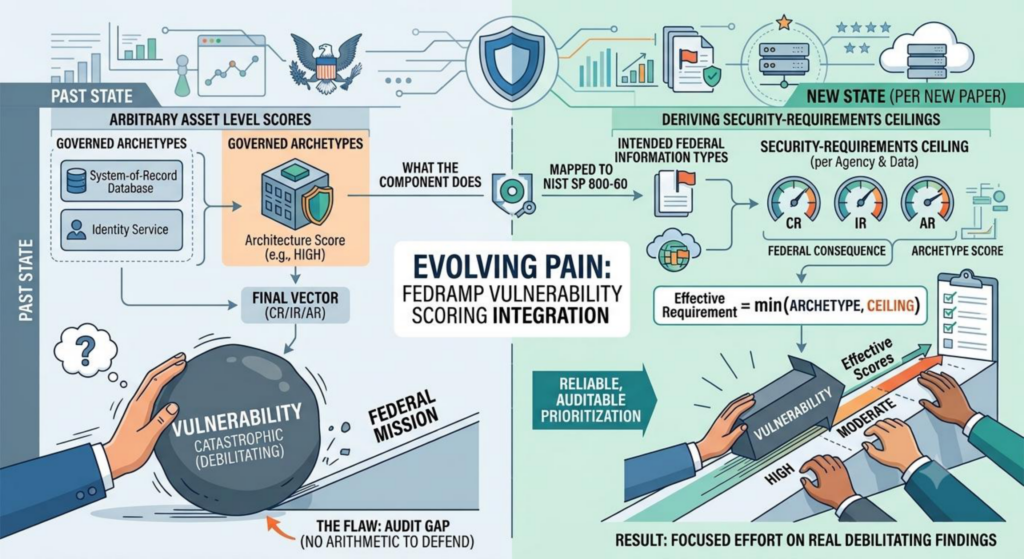
Potential Agency Impact (PAIN) ratings describe consequences ranging from minimal, narrowly scoped effects to disruptive, debilitating effects across one or more agencies. The framework incorporates criticality, reachability, exploitability, detectability, prevalence, privilege, known threats, and interactions with other vulnerabilities.
Potential Agency Impact N-Ratings
N1: Minimal effect
N2: Narrow effect
N3: Disruptive effect on one agency
N4: Debilitating effect or disruptive multi-agency effect
N5: Debilitating effect across multiple agencies
This is more than a new classification added to the end of a scan report. It changes the unit of analysis. The unit is no longer simply the vulnerability; it is the vulnerability within a particular architecture, supporting a particular business process, serving particular agency missions, under a particular set of operating conditions and controls.
That shift requires informed engineering judgment supported by evidence.
The Mission Defines the Consequence
Consider the same CVE in two cloud services. The first is a project-management application used by a small team to track non-sensitive work. The vulnerable component is not directly internet-reachable; exploitation requires authenticated access, the affected function is isolated, and compensating controls limit lateral movement.
The second service supports time-sensitive government operations. It processes sensitive information, is broadly deployed across an agency, and depends on the affected component for a critical availability function. Exploitation could interrupt operations or create a path to privileged access. The technical defect may be identical. The CVSS Base score may be identical. The mission consequence is not.
The Agency Owns the Appetite; the Provider Supports the Decision
A cloud provider can explain the applicable requirement, describe how it interprets that requirement, identify credible risks, provide supporting evidence, and recommend a course of action. It cannot establish one universal level of acceptable residual risk for every federal use case.
For agency use, that judgment ultimately belongs to the agency and its authorizing officials, informed by the mission, the data, the operating environment, and the consequences they are responsible for accepting.
That creates uncertainty for providers pursuing a sponsorless path, preparing for an initial assessment, or serving multiple agencies. The uncertainty reflects a basic reality: risk appetite and mission consequence vary by customer and use case.
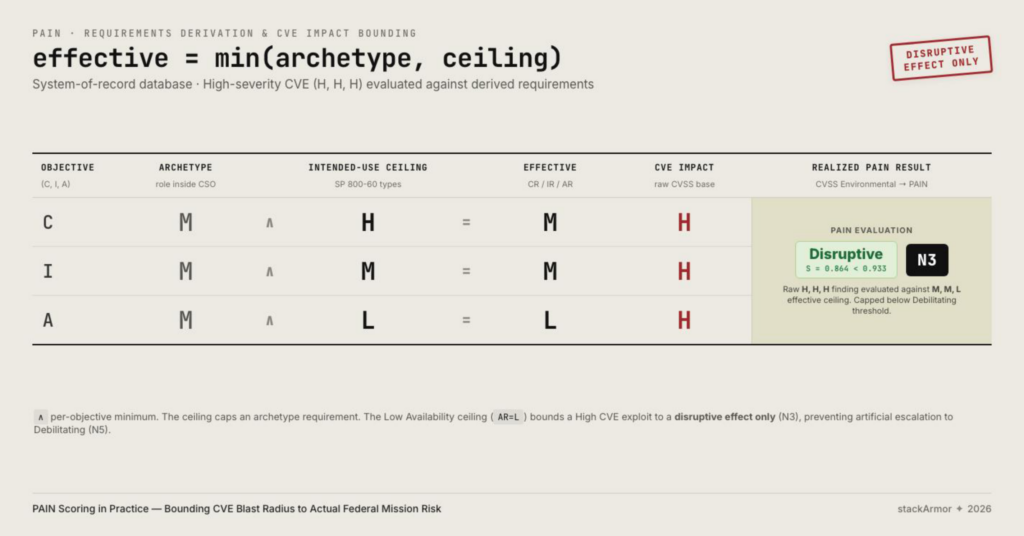
The first prerequisite is an accurate understanding of what information the service stores, processes, or transmits and which mission and business processes depend on it. NIST SP 800-60, Volume I, Revision 1 provides the foundation: identify information types, map them to confidentiality, integrity, and availability objectives, review provisional impact levels in context, and document the rationale for adjustments.
NIST cautions that incorrect categorization can either waste security resources through overprotection or expose important operations and assets through underprotection. The same service may support public information for one customer and operationally sensitive activity for another. Accurate categorization is therefore more than a documentation exercise; it is the basis for aligning safeguards with mission consequence.
Under CR 2026, the governing lens is government mission risk. Provider risk models can inform the analysis, but they cannot replace the agency’s mission context.
A defensible evaluation should consider the data involved, the mission the system supports, the agencies relying on it, the route by which an attacker could reach the vulnerable component, authentication and privilege requirements, plausibility of exploitation, blast radius, controls already in place, and operational consequences of degradation or loss.
Context Must Be Supported by Evidence
Statements such as “not exploitable in our environment” or “compensating controls are in place” can be appropriate conclusions, but they must be supported. The relevant evidence may include architecture, configuration, telemetry, test results, control performance, and documented assumptions.
Contextual risk analysis is not arbitrary. It should be repeatable, reviewable, and open to challenge. Another qualified reviewer should be able to follow the reasoning, examine the evidence, and understand how the conclusion was reached.
Elements of a Defensible Vulnerability Evaluation
- Identify affected resources, customer scope, and mission dependencies.
- Map credible attack paths, reachability, and exploitation preconditions.
- Validate mitigations with operational evidence and control telemetry.
- Record confidence, assumptions, review triggers, and rating history.
Risk Changes Over Time
Traditional compliance workflows often treat a risk determination as a durable artifact. A finding is analyzed, assigned a rating, placed on a schedule, and revisited during the next reporting interval. CR 2026 points toward a more dynamic model.
Risk changes when a proof of concept is published, a component becomes internet-reachable, an identity boundary is weakened, a new customer adopts the service, an agency begins using the product for a more critical function, or a compensating control stops performing as expected.
It also changes when attacker capability changes.
Artificial intelligence is reducing the time, expertise, and cost required to perform reconnaissance, analyze code, adapt public exploits, and automate portions of an attack chain. AI does not make every vulnerability immediately exploitable, and skilled attackers still matter. It does, however, change the economics and speed of exploitation—and that can change risk even when the vulnerable code itself has not changed.
A vulnerability that was impractical to weaponize twelve months ago may become more accessible as tools, techniques, and public knowledge evolve. Five Eyes cybersecurity agencies warned in June 2026 that AI is lowering barriers for malicious actors and shortening the interval between vulnerability discovery and exploitation. FedRAMP’s rules likewise direct providers to assume exploitation can be automated unless evidence demonstrates otherwise.
A risk decision should be treated as a current assessment supported by current evidence—not as a permanent conclusion.
The Ecosystem Was Built for a Different Operating Model
FedRAMP’s direction is likely to strengthen the connection between compliance activity and real-world security outcomes. Reaching that destination, however, will require changes across the ecosystem.
Most vulnerability tools were designed to produce deterministic findings. Most governance, risk, and compliance platforms were designed to track those findings against deadlines. Many procedures assume that numerical severity can be mapped directly to remediation priority. Meanwhile, compliance, engineering, security operations, product, and mission owners often work through separate systems and incentives.
That model is efficient when the desired output is a prioritized list. It is less effective when the desired output is a defensible explanation of risk.
Providers will need stronger connections between asset inventories and mission functions, vulnerabilities and attack paths, customer use and potential agency impact, and compensating controls and operational evidence. Threat intelligence will need to inform prioritization continuously. Risk decisions should be versioned, reviewable, and machine-readable where practical.
Automation Becomes More Important—not Less
Scanners will remain indispensable, but their role becomes clearer: they are sensors and evidence sources, not stand-alone decision-makers.
The goal should be to automate evidence collection, exposure analysis, control validation, change detection, and reassessment triggers. Automation can make judgment more consistent and scalable without attempting to eliminate judgment from the process.
The future is not “compliance versus engineering.” It is compliance demonstrated through engineering evidence.
Risk-Based Does Not Mean Permissive
One of the easiest ways to misunderstand this shift is to interpret flexibility as a lower bar. In practice, contextual risk management can be more demanding than deterministic compliance because it requires providers to understand and explain their data, architecture, dependencies, customers, controls, and failure modes.
A checklist can confirm that required activities occurred. A defensible risk decision must also show why the conclusion is reasonable, what assumptions support it, what evidence was considered, and what conditions would trigger reassessment.
Organizations that document assumptions, provide evidence, respond to new information, and improve controls should be distinguishable from organizations that use “risk-based” language without the supporting discipline.
Certification must continue to communicate something meaningful. That requires accountability when a provider persistently fails to monitor its environment, respond to program requirements, or protect its customers. The objective is not to penalize organizations navigating a difficult transition in good faith; it is to ensure that certification reflects an active security capability rather than a historical achievement.
Short-Term Disruption Is Part of the Transition
The transition will be challenging. Providers will redesign processes that have been stable for years. Assessors will evaluate not only whether evidence exists, but whether the reasoning supported by that evidence is credible. Agencies will interpret risk in the context of their own missions. Security teams will need deeper product and architectural knowledge, while compliance professionals will need closer working relationships with engineering, operations, and threat-intelligence teams.
Tooling will lag the operating model. Different organizations may initially classify similar vulnerabilities differently. Review cycles may involve more discussion before they produce better decisions. Some organizations will discover that their asset, data-flow, control, and customer-use information is not yet sufficient to support credible impact analysis.
That friction should be expected. It reflects the work required to move from a primarily deterministic reporting model toward a more contextual risk model.
From Vulnerability Management to Risk Engineering
Success under CR 2026 will not be defined by vulnerability counts alone. A low finding count can reflect excellent engineering, limited visibility, or a narrowly tuned scanner. The number requires context.
Organizations will be better positioned when they can consistently explain why a vulnerability matters, why another finding presents a different level of risk, what exploitation would mean to the mission, which controls reduce that consequence, how confident they are in those controls, and what changes would require the decision to be revisited.
They will also understand where provider expertise ends and agency judgment begins.
That changes the role of the security and compliance advisor. The goal is not to provide an absolute answer to every question. It is to make requirements, evidence, tradeoffs, and residual risk clear enough that customers can make informed decisions—and defend them.
That capability cannot live solely in a policy document or quarterly review. It must be integrated into architecture, product development, security operations, customer onboarding, change management, and continuous monitoring.
CR 2026 is bringing risk back to the center of vulnerability management. Organizations that embrace that shift will do more than satisfy a new set of rules. They will build security programs that better reflect how cloud systems fail, how adversaries operate, and how government missions depend on technology.
Compliance remains essential. The next step is connecting it more directly to evidence, judgment, and mission consequence.